
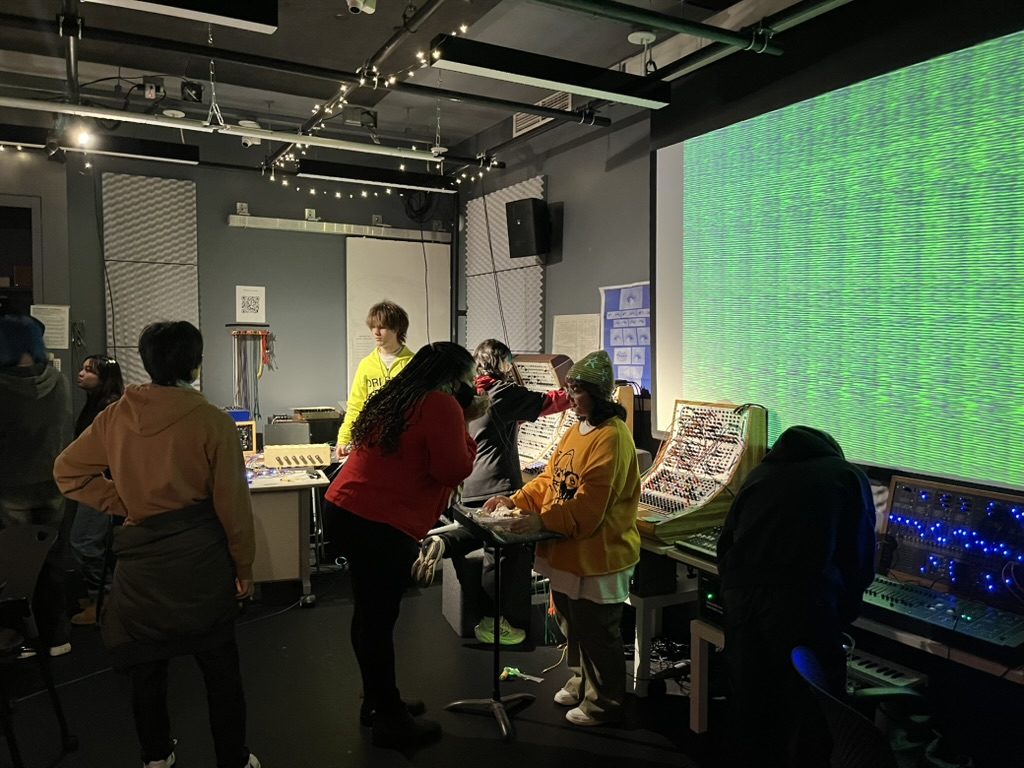
Passing the Audio Lab at the NYU Tandon School of Engineering, it may surprise you to hear crickets chirping and see fireflies flickering inside. It’s student engineers busy at play! They’re immersed in Analog Heaven, an Integrated Design and Media course that’s all about the analog nature of electronic media. Faculty members Kelly Heaton and R. Luke Dubois teach students to build the hardware that brings circuits to life, helping them understand the foundations of complex electronics. And those crickets and fireflies? They’re actually oscillating circuits complimented by blinking LEDs and programmed to mimic a rural soundscape with handmade signals. Scenes like this one, where engineering meets creativity, are the essence of Analog Heaven.
Meet the Faculty
“Analog Heaven is a hands-on immersion in the origins of electrical engineering,” says Professor Heaton. She’s an alumna of the MIT Media Lab and a cross-disciplinary artist and engineer who works with electricity. “It’s a gateway to understanding the fundamental building blocks of modern electronics through the lens of creativity, material intuition, and signal flow.”
In contrast to Professor Heaton’s engineering background, Professor Dubois is an electronic musician and composer. He not only teaches students about analog synthesizers but also provides historical context on how humans process sound. So, he’ll demonstrate how to make electronic music while Professor Heaton teaches students how circuits work and how to build them. “The balance of my role with Professor Dubois’ musical extravaganza forms a perfect learning environment,” says Professor Heaton.
“The class is highly collaborative and involves a lot of experiential learning. Students make work in nearly every class,” says Professor Dubois. The “cricket” class period is one of his favorites. “It’s the class where we finally get everyone’s first circuits working. You can see them all realize that they can do this type of work.”
The Seashell Synthesizer
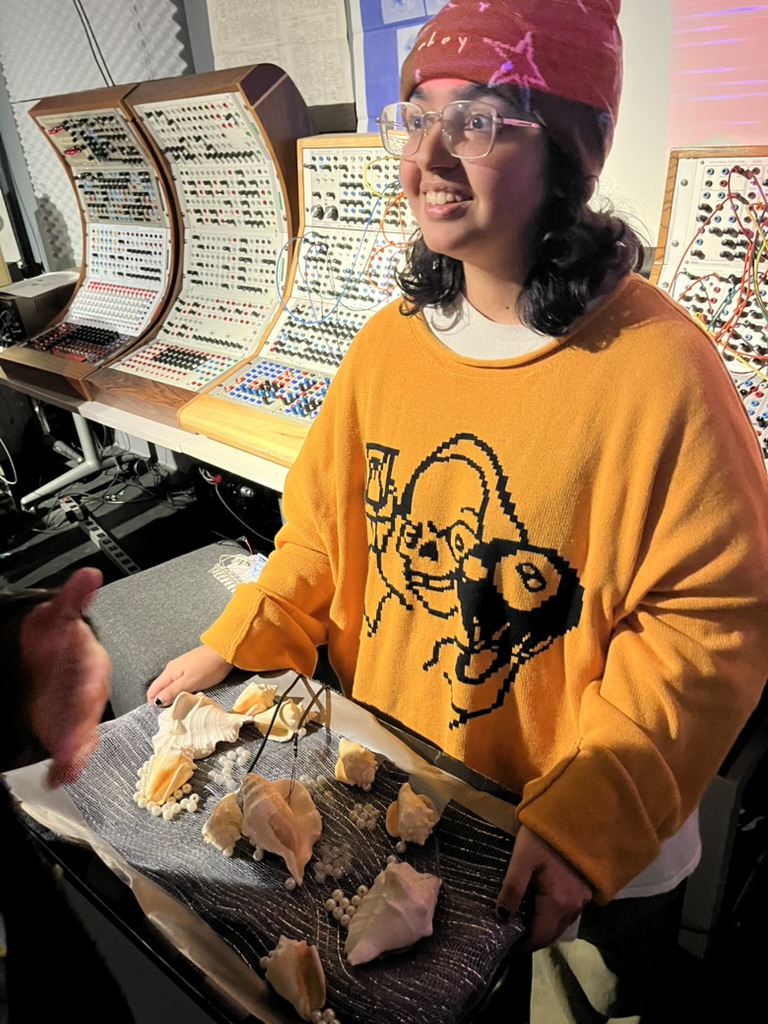
Analog Heaven awakened curiosity in senior Abrar AlMari. She started by learning the engineering behind electronic music machines. Then, she tapped into her creativity to engineer her own sound devices with tools like resistors, capacitors, and transistors. Her final project brought everything together.
“I made seashell contact mics using ceramic piezo discs and actual seashells,” she says. “I soldered the discs to audio jack wires and glued them into the seashells, which are naturally resonant. This allowed the discs to pick up their vibrations. Then, I connected the shells to a giant synth so that when you whispered into or dropped the seashells they would trigger different sounds and musical tones.” Despite entering the course with no prior knowledge of circuitry, Abrar realized how much her knowledge and confidence had grown with her final project.
From a Circuit Garden to a Robotic Church
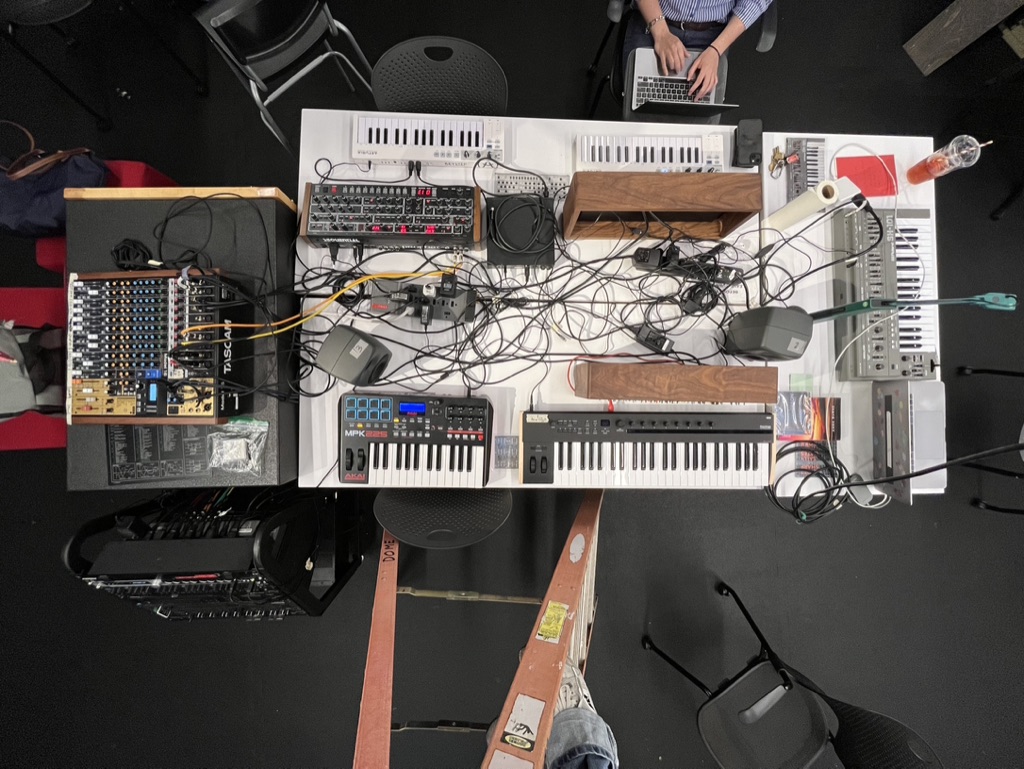
Another student, Nour Marie-Kemi Acogny, found a similar sense of freedom and playfulness during Analog Heaven. She enrolled after seeing Professor Heaton’s installation Circuit Garden, a life-size garden made of circuits. “I was blown away,” Nour says. “The installation felt alive. She had created this entire soundscape using only discrete components—no recordings, just circuits.” After Nour shared her enthusiasm, Professor Heaton gave her the tools to build her own astable multivibrator oscillator circuit, a type of circuit Professor Heaton frequently uses in her art. “That small moment of being invited in stuck with me,” Nour explains.
In addition, she recalls one memorable class period when students visited the electronic artist Chico MacMurtrie’s Robotic Church in Red Hook, Brooklyn. There, they got a rare, personal tour of the space, which is filled with kinetic robotic sculptures. What’s more, they witnessed a performance by MacMurtrie’s robots—an experience that left a lasting impression. “I’d never seen anything like it. That kind of immersive, real-world exposure added to what made this course feel so alive,” says Nour.
The Importance of Creativity in Engineering
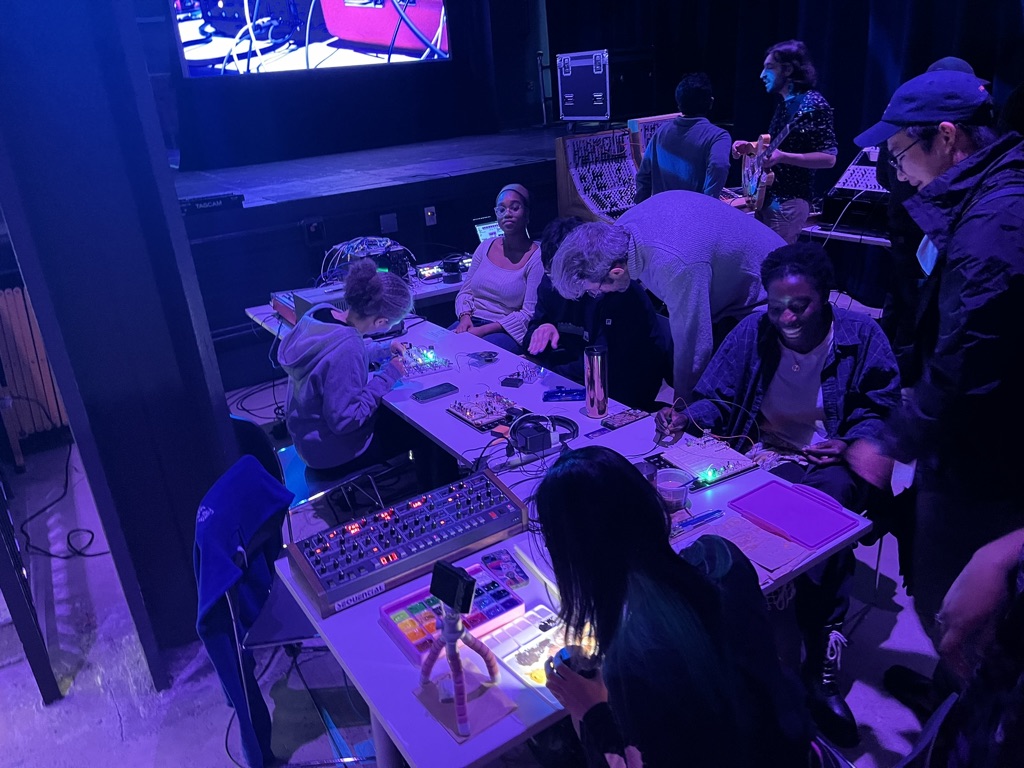
As our world becomes increasingly digitized, so much so that many individuals aren’t sure exactly how electronics work on a physical level, courses like Analog Heaven bring machines back into perspective. A useful lesson not only for engineers, but for everyone. Simultaneously, students have the space to be creative and to tinker—to try, to fail, and to try again. “Analog Heaven isn’t about ‘being smart’ or ‘passing the test’ but about confronting a blank breadboard, sticking components in all the wrong places, and not quitting until the circuit works,” says Professor Heaton.
For Nour’s final project, she attempted to duplicate Professor Heaton’s installation, the one that had first inspired her to take the course. She injected new elements, like making it interact with a modular synthesizer. Once completed, she could see how much her understanding had developed since the course’s beginning. “This project was the first time I felt like I’d built something meaningful with my own hands, and it reminded me that progress matters more than perfection,” she says. “I could see how far I’d come—from not knowing how to read a schematic to being able to understand, interpret, and build something as beautiful and intricate as Professor Heaton’s circuits.”
Related
NYU Tandon’s Emerging Media Playground @ The Yard
NYU Tandon @ the Yard, an emerging media lab, offers students the chance to explore extended reality (XR), virtual production, and more.
Integrated Design and Media at NYU: Be a Creative Engineer
As an NYU Tandon student, NYU Ambassador Katrina combined an interest in STEM with a passion for the arts through the Integrated Design and Media Program.

Innovate and Create at the Leslie eLab
NYU’s Mark & Debra Leslie Entrepreneurs Lab, or the Leslie eLab, allows entrepreneurs across NYU to connect, collaborate, and explore.