Published October 23, 2025
Improving Care and Well-Being, One Experiential Research Project at a Time

At NYU, research isn’t just for faculty members and graduate students. Across schools and campuses, undergraduates explore big questions, uncovering new knowledge that has a real-world impact. What’s more, they’re making the most of the University’s expansive resources to personalize their academic paths, gain experience, and put what they’ve learned in class into practice. Here are just a few ways NYU students are improving human health, well-being, and care through research.
Wondering where research at NYU can take you? Then read on to learn about three students creating a better world through their research projects.
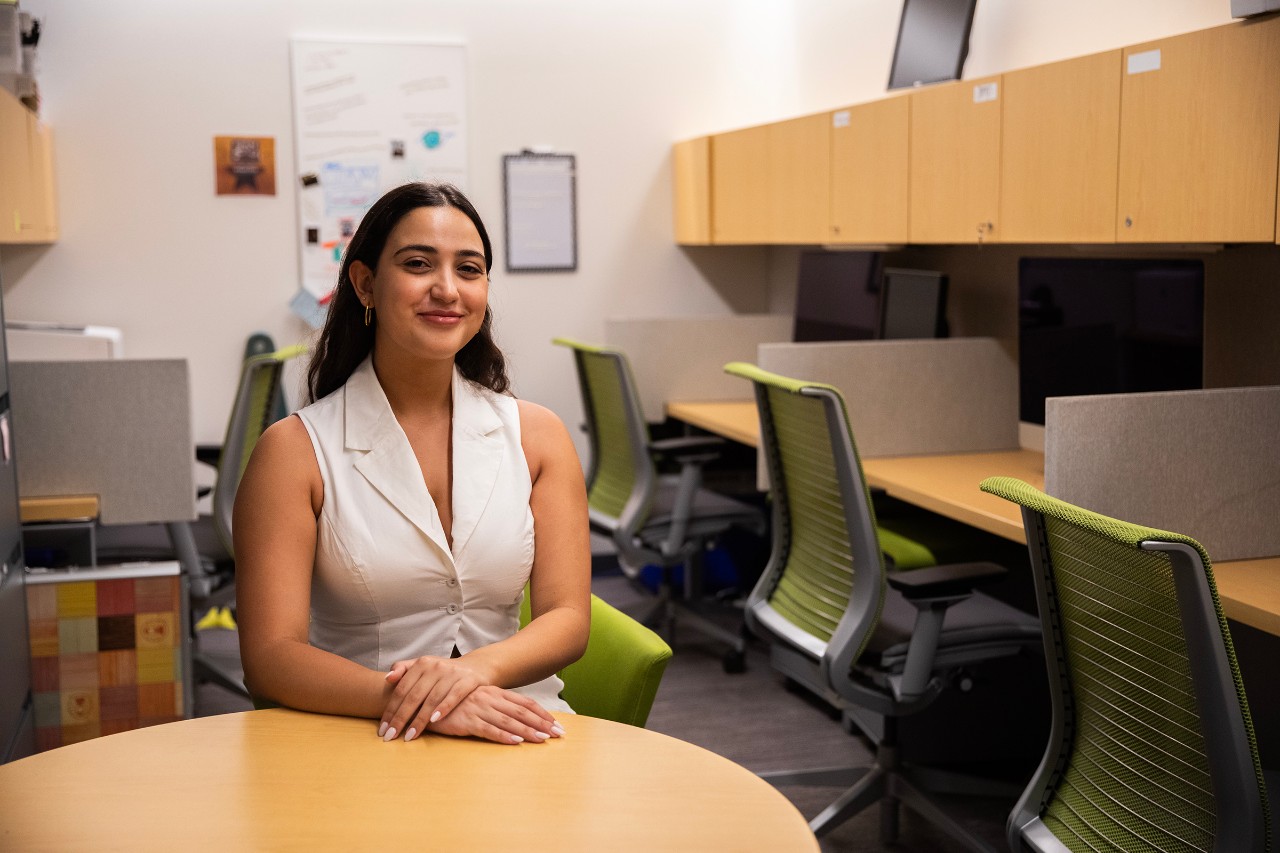
Jida Haddad Investigates System Justification
How do our beliefs affect what we see? For Jida Haddad, College of Arts and Science Class of 2025, this question led to a thesis exploring visual confirmation bias in criminal investigations. “I wanted to do something at the intersection of law and psychology,” the Psychology major says. So, she worked alongside Professor Emily Balcetis in her Social Perception Action and Motivation Lab. There, Jida investigated whether people who tend to justify existing systems interpret police evidence in ways that align with their beliefs.
In a simulated investigation, participants viewed a police sketch and a man’s photo. Additionally, they learned this photo was supposedly identified through AI as a potential match. Then, they were told a background story. One group learned he’d pushed someone onto subway tracks, another read he’d saved someone, and a control group received no contextual information. “We wanted to look at how many similarities they focused on, and whether that aligned with their beliefs about the man’s guilt,” Jida explains. The results? Two people looking at the same image could interpret it completely differently—evidence for visual confirmation bias. Now headed to a law firm, Jida says studying psychology “provides a really strong foundation for legal work.”
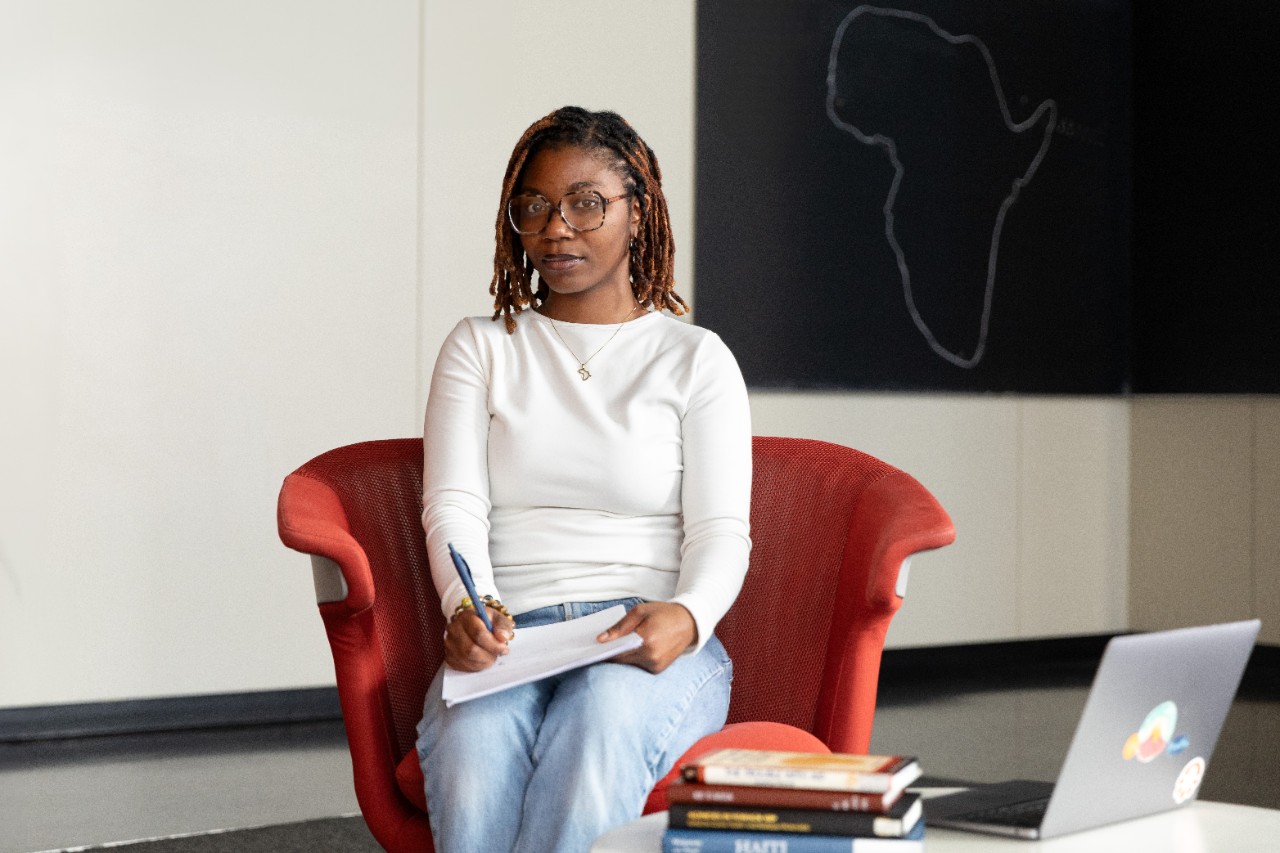
Maame Adwoa Sey Examines the Politics of Aid
Maame Adwoa Sey, Liberal Studies Class of 2025, found that the effects of foreign aid aren’t just economic—they’re political. Her project compared how Ghana, Tanzania, Rwanda, and Haiti have used foreign aid to develop their health systems and infrastructure. “Aid is usually tied to a specific agenda, and oftentimes that agenda doesn’t match what the country needs,” she says. As a result, countries may accept aid only to find that the donor’s priorities shape the outcome.
Maame’s interest was sparked during a year abroad at NYU Accra, where she interned with Concern Health Education Project. “I looked at the gaps between policies and what community members are experiencing,” the Global Public Health/Global Liberal Studies major explains. What’s more, conversations with local health workers, policymakers, and her professor, Roger Atinga, helped her understand how communities work around limited government support. “That made me want to look into why nongovernmental organizations have to go outside of their own country to receive money.” Inspired by the experience, she worked on public health in Namibia with the Peace Corps this August. “After that,” she continues, “I want to be a diplomat.”
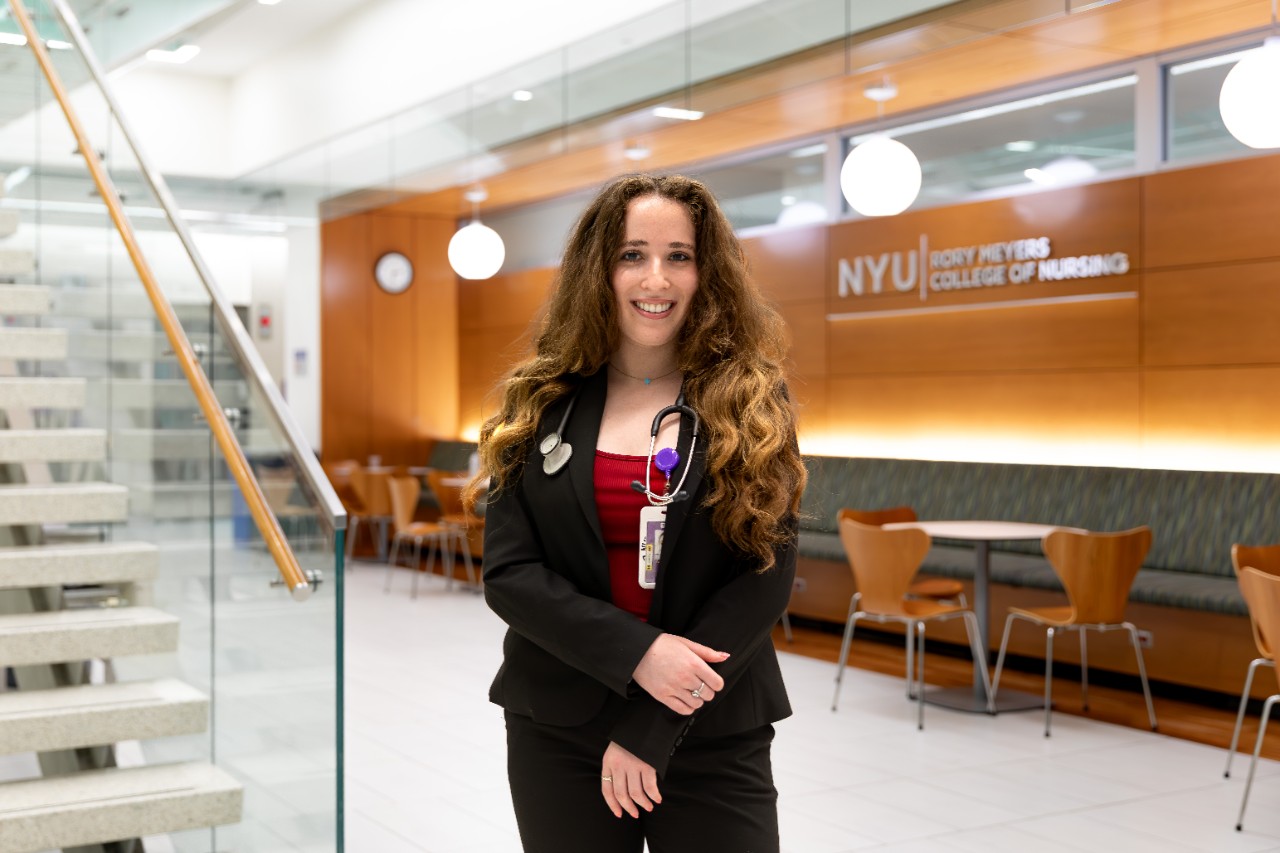
Veronica Reznikov Improves Care for the Smallest Patients
For her LEAD Honors Program capstone project at the Meyers College of Nursing, Veronica Reznikov, Class of 2025, focused on a place close to her heart: the neonatal intensive care unit (NICU). “I was a NICU baby myself, and my twin sister had a lot of complications,” she says. “I wanted to make a difference like the nurses made in my family’s life.” So with guidance from Professor Michele Crespo-Fierro, Veronica examined how iatrogenic blood loss—blood loss from medical procedures—affects extremely premature infants.
“We noticed a correlation between blood loss and adverse outcomes like sepsis, necrotizing enterocolitis, and anemia of prematurity,” she explains. To better track blood loss, the team implemented a protocol using NYU Langone Health’s electronic medical record system. But when nurses struggled to log the data, Veronica manually reviewed charts and estimated blood loss based on lab orders. “It made me think about just how difficult our job is,” she says. Now she’s brainstorming solutions like pop-up alerts triggered by ID scans to make tracking easier. Ultimately, the project helped her land a job in the same unit of NYU Langone Health’s NICU.
Related

Health Equity at NYU
At NYU, we believe that health care is a basic human right. We are preparing students to become outspoken advocates for health equity through education, research, policy work, and outreach.
Nursing at NYU: Better Care for a Better World
Jasmine Travers teaches NYU Meyers students to provide exceptional nursing care and advocates for health equity and workforce diversity.
At NYU, Research Is for Everyone (Part One)
Explore NYU’s extensive research network where you have opportunities to advance your field—and the world—with your research.