Published October 01, 2026
This or That: Journalism vs. Media, Culture, and Communication at NYU


So you’re interested in a career in journalism or media, and you’re looking for the best major to help you get there. Lucky for you, NYU offers several options that cover both fields. But with over 230 areas of study across 10 undergraduate schools, it can be tricky to find the right home within the NYU-niverse. Especially when you’re trying to decide between two similar majors, like Journalism at the College of Arts and Science (CAS) and Media, Culture, and Communication at Steinhardt. Don’t worry—we’ll break down the differences between the two.
Quick disclaimer: Before we go into the specifics of Journalism and Media, Culture, and Communication, it’s worth noting that both programs focus on preparing you with flexible skills for quickly evolving industries. In addition, internship experiences are critical in shaping what you ultimately decide to pursue in your career.
Journalism
The Journalism major at CAS is for students who want to study reporting theory and practice. The program requires you to take on a second major, which you use to create a specialized beat. After you’ve declared your Journalism major, you choose between the print/online track or the broadcast track. The resulting degree is a Bachelor of Arts (BA) in Journalism.
Maybe you decide on Cinema Studies as a second major, focusing your reporting on film and television. Your studies might be the perfect springboard to an internship at a TV network—in fact, one student landed a dream senior year internship at MTV! Or maybe you choose a second major in Politics, following aspirations to become the next Anderson Cooper.
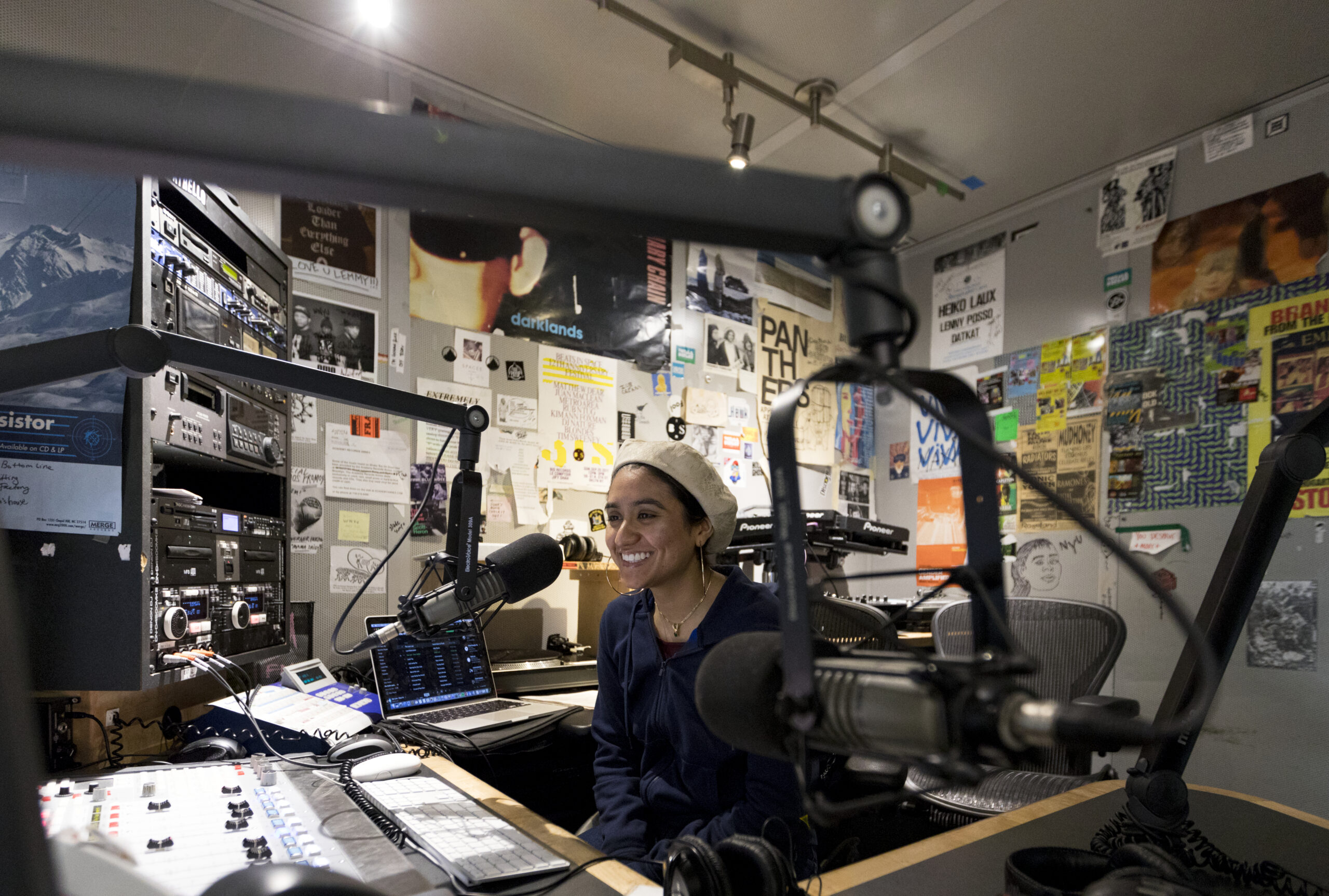
For Delia Apetroaei, a junior on the broadcast track, Physics is the ideal second major because it allows her to balance her creative and scientific interests. She taps into both when producing a podcast for WNYU, NYU’s student-run radio station. Her show, called Fallen Apples, breaks down the physics behind everyday phenomena: For example, why does food taste different on an airplane?
“I wanted to use my skills for a passion project outside of class. I love it because it involves me doing research and educating myself on how things work,” Delia says. “I’m currently enrolled in the Journalism Multimedia class, where I’m learning to edit audio, video, and photos. I’m taking the skills I’ve learned in class and growing them in different ways.”
Whatever you choose to double-major in, you’ll gain exposure to a different discipline and develop expertise in your field, giving you an extra edge in the job market. Journalism majors from NYU have gone on to careers at prominent news organizations and publications like The New York Times, The Washington Post, NBC News, and Vanity Fair.

Media, Culture, and Communication
The Media, Culture, and Communication major at Steinhardt is one of the more challenging programs to describe in a single post. To begin, everyone here calls it MCC.
At MCC, “media” includes all forms of communication technology—writing, advertising, television, video games, AI, and more. Your courses explore the cultural, political, and economic forces that shape communication across the globe and across generations. The resulting degree is a Bachelor of Science (BS) in Media, Culture, and Communication.
MCC students choose to focus on two of five fields of study (though many of the classes for each overlap):
- Global communication and media
- Media industries and politics
- Visual culture and sound studies
- Technology and society
- Interaction and experience
Throughout the program, you’ll learn how to analyze today’s media environment, how it came to be, and how it continues to evolve, all while honing strong critical thinking and writing skills. Along with foundational courses, you can take practical production courses in areas ranging from film and podcasting to digital design and 3D printing.
Junior Yudi Tang was drawn to MCC by her lifelong fascination with storytelling in books, film, and television. She wondered how the media could shape the ways we think, feel, and live. “Instead of chasing one clear answer, I was drawn to the questions,” she says. “Studying MCC felt like the right way to explore the things I enjoy while learning to think critically about them and about myself as a media consumer.”
Although many MCC grads go on to successful careers in the media industry, with alumni at major companies like BuzzFeed, NBCUniversal, and Capitol Music Group, you’re not limited to working in the entertainment industry. MCC is also a great gateway to careers in industries like advertising, law, technology, corporate communications, consulting, and nonprofit work.

Final Thoughts
If you’re still not sure you want to major in journalism or MCC, no worries! Both programs offer a minor, allowing you to explore them without committing to the full program of study.
Hopefully, this clears up some confusion about these two popular majors. As always, feel free to reach out to us for additional clarification—we are here to support you.
Related
Media, Culture, and Communication Alums Do It All
Leverage an innovative academic experience into a range of career pursuits.
Tisch Interactive Media Arts: Everything You Need to Know
Explore NYU’s Interactive Media Arts (IMA) program and discover how you can combine technology and creativity in your college studies.
NYU Journalism Students all Double Major: Here’s Why
Whether it complements your studies, helps you specialize, or enables you to branch out into something new, a second major is a powerful tool for journalism students.